

On May 21–22, 2026, the Canadian Repair Convention brought together researchers, policymakers, industry leaders, advocates, and community members at the Schulich School of Law at Dalhousie University in Halifax, Nova Scotia, for two days of discussions and demonstrations celebrating and advancing the #RightToRepair in Canada. Made possible through funding from the Social Sciences and Humanities Research Council of Canada (SSHRC), with support from the Law & Technology Institute and the MacEachen Institute for Public Policy & Governance at Dalhousie University, the convention featured keynote addresses and panel discussions exploring the relationship between repair, the environment, the economy, community empowerment, computerisation, public policy, and Canada’s future.
One of the convention’s sessions, Repair and a Resilient Canada, explored how the right to repair extends beyond consumer ownership and plays an essential role in strengthening Canada’s critical infrastructure and public services. Throughout the panel, speakers considered how Canada’s ability to repair and maintain essential equipment has become increasingly important in an era of geopolitical uncertainty and ongoing supply chain disruptions. Joining the panel were Kevin Taylor, Co-Chair of the Right to Repair Committee for the Canadian Medical & Biological Engineering Society (CMBES); Michael Sideroff, Senior Biomedical Engineering Technologies Team Leader for the Canadian Armed Forces; and Alan Spurway, Clinical Engineer with Nova Scotia Health. The discussion was moderated by Dr. Anthony Rosborough, Assistant Professor of Law & Computer Science at Dalhousie University.
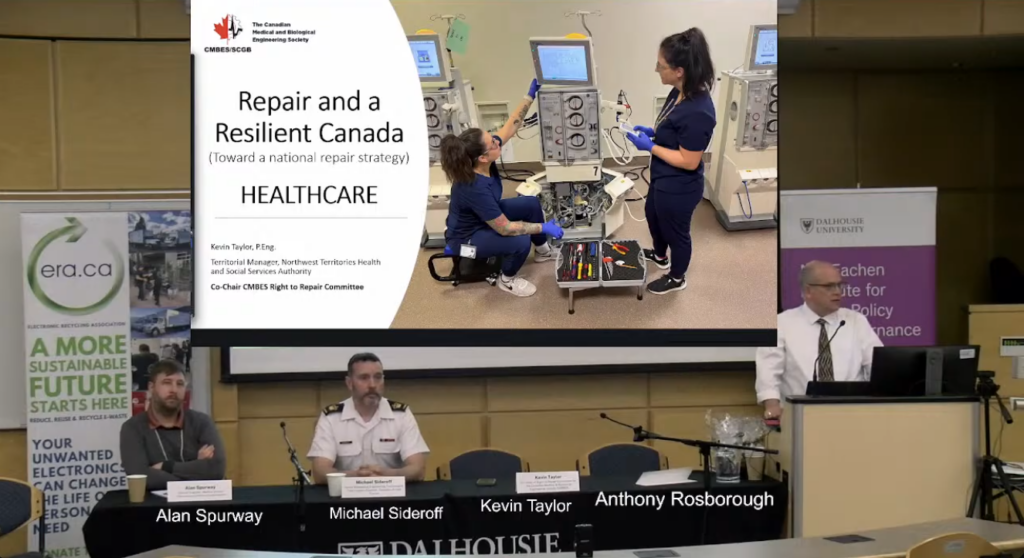
Much of the discussion focused on medical devices and healthcare systems as a case study for understanding the consequences of repair restrictions on critical infrastructure. Panellists emphasized the importance of ensuring that Canada’s essential services remain reliable and resilient. They also explored the ongoing tension between public institutions that require timely access to tools, parts, and repair information, and manufacturers who continue to restrict that access in an effort to retain control over servicing their products.
Kevin Taylor emphasized the real-world consequences of repair restrictions within healthcare. As he explained, “By blocking the right to repair, manufacturers are, in an effort to monetize services, knowingly causing safety issues and delays in care.”
While repairs to medical devices are often perceived as a safety or liability concern, Taylor pointed out that the greater risk frequently comes from delaying repairs. When critical healthcare equipment remains out of service, patient wait times increase and access to timely care is reduced. Beyond the immediate impact on individual patients, these delays can also weaken healthcare systems’ ability to respond during periods of heightened demand or crisis. Panellists noted that a 2018 analysis by the U.S. Food and Drug Administration (FDA) found no evidence that third-party servicing created additional risk, while recognizing the importance of independent servicing to the sustainability of the U.S. healthcare system.
The discussion also highlighted the importance of repair within the Canadian Armed Forces. Michael Sideroff explained that military operations often take place in locations where civilian service technicians cannot access equipment. In these environments, the ability to maintain and repair medical equipment on site plays a crucial role in operational readiness and ensuring timely access to care.
Despite the critical and often time-sensitive nature of these sectors, manufacturers continue to prioritize maintaining control over products and repair services, even when doing so results in higher costs and unnecessary delays. Taylor shared an example of a hospital experiencing significant disruptions after a medical device broke down. Rather than supplying a small replacement part, the manufacturer instead offered to provide a loaner machine worth thousands of dollars. The example illustrated how manufacturers may be more willing to replace an entire device than enable a simple repair, creating unnecessary dependence and increasing vulnerabilities within critical public services.
Alan Spurway also discussed the challenges healthcare organizations face when repairing equipment. Although hospitals technically own their medical devices and can make modifications, doing so often removes the equipment from its validated state, transferring responsibility and liability for any future issues onto the organization. As a result, many institutions avoid making repairs or modifications despite having the capability to do so.
The panel concluded by framing the right to repair as an issue of national resilience. In an era marked by economic uncertainty, geopolitical instability, and ongoing supply chain disruptions, Canada’s ability to repair and maintain critical infrastructure has become increasingly important. When healthcare providers, the military, and other essential public services lack access to the parts, tools, or information needed to repair equipment, the consequences extend far beyond individual consumers—they affect the resilience, preparedness, and well-being of Canadians as a whole.
This write-up was based on reporting prepared by Convention Rapporteur Amashi Wasala, a Political Science student at Dalhousie University.
Interested in learning more? A recording of this panel, along with other sessions from the 2026 Canadian Repair Convention, is available here: https://www.youtube.com/watch?v=mRl7vVq94Mo&list=PLS-R-OiK_f6lYN0Oi_kLhKD3iZyzZ2Vm3
Leave a Reply