


Canada’s right to repair movement has been very active in 2026, with three significant legislative developments at the federal and provincial levels. Federally, Bill C-267 proposes a national framework for improving the durability and repairability of consumer electronics and household appliances. Meanwhile, Alberta has introduced Bill 34, which proposes more direct obligations on manufacturers to provide access to repair resources. Manitoba has gone a step further in the legislative process, with Bill 15 receiving Royal Assent in June 2026.
The three approaches differ in their scope and legal effects, together they reflect growing recognition of the importance of access to the parts, tools, software, and technical information needed to repair modern products. And although these bills do not specifically target medical devices, each provides important insights into the direction of right to repair policy in Canada. They also raise questions about whether emerging legal protections for consumers and independent repair businesses might eventually extend to the specialised equipment used in Canadian hospitals and healthcare facilities.
For the Unlocking Healthcare project, these developments represent both progress and an opportunity to consider how right to repair principles could be adapted to the medical device sector.
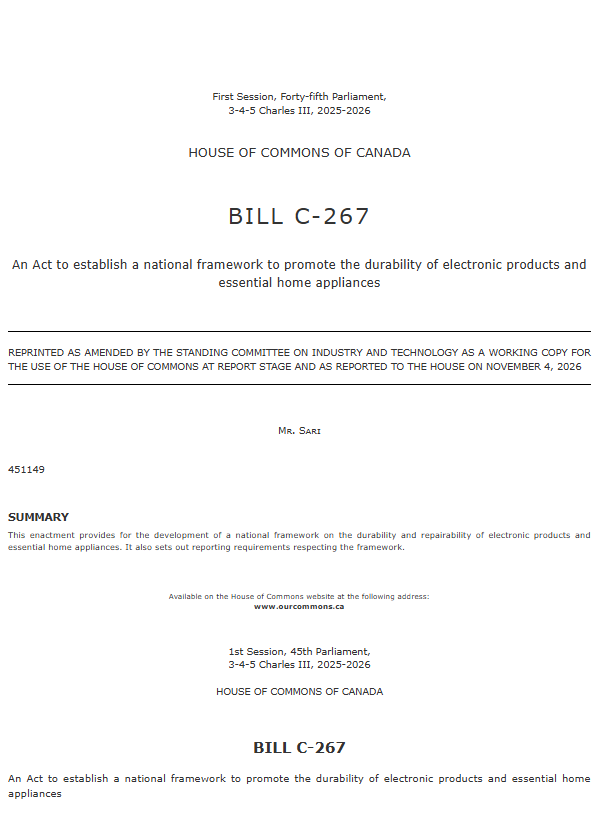
Bill C-267: A National Framework for Durability and Repairability
Introduced in March 2026 by Liberal MP Abdelhaq Sari, Bill C-267, the National Framework on the Durability of Electronic Products and Essential Home Appliances Act, passed second reading in the House of Commons on June 17 and was considered by the Standing Committee on Industry and Technology. Consideration by the Committee was completed on November 4 and the Bill is now in the reporting stage.
The bill proposes that the federal Minister of Industry develop a national framework to promote longer lasting and more repairable “electronic products” and “essential household appliances” that are offered for sale, distributed, or sold in Canada, whether they are made in Canada or imported.
Among other things, the proposed framework would address:
- Transparency concerning the minimum useful life of products and product labelling;
- Availability of replacement parts, repair tools and technical documentation;
- Access to maintenance and repair information;
- Duration and conditions of software support; and
- Responsibilities of manufacturers, importers and distributors.
These are meaningful considerations for improving product longevity. However, Bill C-267 is relatively limited in its immediate legal effects. Rather than directly requiring manufacturers to supply replacement parts or repair information, it would require the federal government to develop a framework, consult with provinces, and “consider” appropriate legislative measures. It is not clear exactly what this proposed framework is intended to accomplish or require.
Nevertheless, it is conceivable that this framework could eventually support mandatory product standards, including obligations on manufacturers. It could also encourage greater transparency through labelling or durability and repairability ratings, helping purchasers make more informed decisions.
This approach emphasises better information and longer lasting products, but leaves the implementation of an enforceable Right to Repair to future policy decisions.
What does C-267 mean for medical device repair?
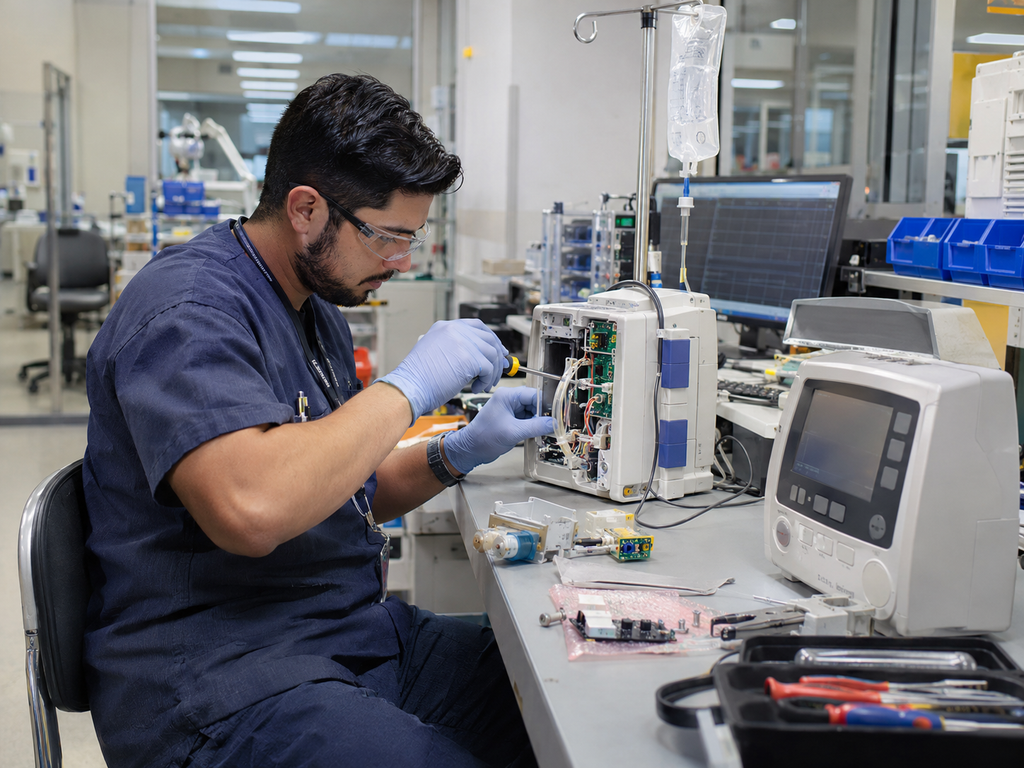
As mentioned above, Bill C-267 is directed toward consumer electronics and essential household appliances. Its current scope does not extend to medical equipment purchased and maintained by hospitals and other healthcare institutions.
Despite its consumer-oriented focus, C-267 provides a potentially useful model for thinking about medical device procurement and servicing going forward. For example, information about the expected service life of a medical device, the availability of replacement components, the duration of software support, and the accessibility of repair documentation could help healthcare institutions make better purchasing decisions.
A comparable framework for medical devices could allow hospitals to evaluate more than just the initial purchase price of equipment, but also its long-term maintainability and associated servicing costs. However, as we know from other contexts, transparency alone cannot guarantee a tangible Right to Repair in practice. Knowing that a device is difficult to repair is not the same as having the legal right or practical ability to repair it.
For healthcare institutions already operating expensive, specialised medical technologies, access to the resources needed to maintain existing equipment (e.g., training, service keys, updates, replacement parts) may be more immediately important than product ratings or purchasing information.
Alberta’s Bill 34: A Broader-Based Approach to Provincial Reforms
On October 28, 2026, Alberta introduced Bill 34, the Service Alberta and Red Tape Reduction Statutes Amendment Act, 2026. The Bill passed second reading on November 3.
Among several proposed changes to Alberta’s Consumer Protection Act, the Right to Repair portions of the bill would establish a new provincial statutory framework requiring manufacturers to provide access to repair resources.
Unlike the federal proposal, Alberta’s legislation moves beyond transparency and information for consumers toward an enforceable obligation to provide repair resources. This is more in line with the types of reforms we have seen proposed in Canadian provinces and U.S. states over the past several years.

The bill defines these resources broadly, including replacement parts, tools, software, technical information and technical publications used to diagnose, maintain or repair products. Importantly this scope can be broadened in the future to include a wider range of resources (e.g., service keys, training, etc).
Under the proposed provisions, manufacturers would generally be required to supply requested repair resources where they are not otherwise publicly or reasonably available, subject to eligibility requirements and exceptions established through regulations.
The legislation would also place limits on the amounts manufacturers can charge for repair resources. Technical information and technical publications would generally have to be provided without charge (though, exceptions could be created via future regulations).
Individuals or organisations suffering losses because of a manufacturer’s failure to comply also must seek remedies through the courts. This might be out of reach for many potential claimants, and a more actionable approach may have been to task an existing administrative body to help field and adjudicate complaints.
Nevertheless, if enacted, Bill 34 represents potentially substantial changes to the Right to Repair in Alberta. Importantly, the Bill is one of relatively few in Canada to explicitly recognises that modern repair often depends on much more than physical replacement parts or the design of products/devices, but also on access to software, diagnostic tools, and specialised technical knowledge from independent organisations and third-parties.
Could Alberta’s Bill 34 extend to medical devices?
The short answer is that it could, even if it does not explicitly do so as initially proposed. This is because of the potential flexibility built into the bill.
Although introduced as an amendment to consumer protection legislation, its proposed Right to Repair provisions are not confined to individual consumers. Instead, the legislation refers to a “requestor,” defined as a person requesting repair resources from a manufacturer.
This wording may create opportunities for businesses, independent repair providers, and potentially institutional users to benefit from the framework.
Unlike many Right to Repair proposals that are expressly limited to consumer electronics, Alberta’s bill also does not establish a narrowly defined list of eligible products in its primary provisions. This raises the possibility that some aspects of the medical device repair ecosystem could eventually fall within its scope.
For example, we know that hospital biomedical engineering departments and independent medical equipment service providers frequently require access to diagnostic software, service information, calibration tools, and replacement components to maintain clinical equipment. Depending on how Alberta develops its regulations, the proposed framework could offer a pathway for improving access to some of these resources.
It must be stated, however, that this possibility remains quite uncertain. Bill 34 gives the provincial government broad authority to establish eligibility requirements, distinguish between different classes of products and requestors, and exempt particular products or manufacturers. It is difficult at this early stage to predict exactly what shape this will take.
Medical devices could ultimately be included, excluded, subjected to more specialised requirements, or disregarded altogether.
There are also important questions about how provincial repair obligations would interact with federal medical device regulations by Health Canada.
For these reasons, Alberta’s legislation should not yet be interpreted as establishing a “Right to Repair medical devices”. But it’s flexibility may accommodate some of the sector’s needs in the future.
Manitoba’s Bill 15: Right to Repair as Consumer Protection
Manitoba has also made significant progress on Right to Repair legislation. Introduced on March 11, 2026, Bill 15, The Consumer Protection Amendment Act, received Royal Assent on June 1, 2026. However, the legislation has not yet been proclaimed into force, and its practical effects will depend heavily on future regulations.

Like Alberta’s Bill 34, Manitoba’s legislation takes a more direct approach to Right to Repair than the federal Bill C-267. It amends the province’s Consumer Protection Act to require suppliers (defined as sellers or manufacturers) of designated consumer goods to provide purchasers with the resources reasonably necessary to repair those products. These “means of repair” expressly include diagnostic devices and software, repair manuals, replacement parts, specialised tools, and other resources that may be prescribed through regulations.
Suppliers must make these resources available for a reasonable period following purchase, at a reasonable price, and within a reasonable time after receiving a request. Repair manuals and other required information must generally be provided free of charge in electronic form. The legislation also requires suppliers to disclose certain exemptions from their repair obligations before a sale takes place.
However, Bill 15 leaves several important questions unresolved. The provincial government retains broad authority to designate eligible products, establish exemptions, and modify requirements on grounds including safety, security, and the protection of proprietary information. The legislation also permits suppliers to require confidentiality agreements in certain circumstances. Remedies for non-compliance are similarly left to future regulations.
Notably, the legislation focuses on providing repair resources to the buyer, rather than establishing a general right of access for independent repair businesses. Indeed, a proposed amendment expressly protecting purchasers’ ability to share repair resources with third-party repairers was defeated during legislative consideration.
What about medical devices?
For the medical device sector, Manitoba’s legislation presents a much more limited opportunity than Alberta’s Bill 34. Although the definition of “repair resources” is relatively broad, the legislation expressly applies to manufactured goods designated by regulation that are sold to consumers in Manitoba. This consumer-focused language makes it less applicable to specialised clinical and diagnostic equipment purchased by hospitals and other healthcare institutions.
Some medical technologies marketed directly to consumers could potentially fall within its scope, depending on how future regulations are developed. However, there is little indication that the legislation, as presently structured, is intended to address institutional medical equipment servicing.
Some medical technologies marketed directly to consumers could potentially fall within its scope, depending on how future regulations are developed. However, there is little indication that the legislation, as presently structured, is intended to address institutional medical equipment servicing.
Nevertheless, Manitoba’s approach provides another useful example of provincial governments recognising that meaningful repair rights require access to software, diagnostic tools, and technical information, rather than simply replacement parts. It also illustrates the limitations in relying on broadly framed statutory rights without clearly defining the products, repair activities, and parties that will ultimately benefit from them.
Looking ahead
The development of Right to Repair legislation in Canada is encouraging, but medical devices remain an important area in which the relationship between ownership, maintenance, and manufacturer control requires greater attention.
Across these different approaches, a common challenge remains in ensuring that broadly stated commitments to the Right to Repair translate into practical, enforceable rights for the people and organisations responsible for maintaining products, devices, and equipment.
Alberta’s Bill 34 may provide an opportunity to explore whether more flexible provincial legislation can accommodate certain aspects of institutional and professional repair. At the federal level, Bill C-267 indicates growing interest in product durability and repairability standards, even as its immediate scope remains limited.
Beyond these proposals, however, there is considerable room for federal leadership through Health Canada’s medical device regulatory framework and further intellectual property reforms.
As these legislative developments unfold, the Unlocking Healthcare team will continue to examine the legal, technical, and practical barriers facing biomedical engineering professionals and healthcare institutions across Canada.
Leave a Reply